Soldering Iron Heat Insert Press
Mechanical press to assist in the linear motion required for installing threaded inserts into plastic parts
The purpose of this project was to increase the accuracy of installing screw inserts into my 3D printed parts. The process of installing a screw insert into a plastic part is delicate and can ruin the entire print if done incorrectly. Most error comes from improper alignment of the soldering iron on the part. Ideally the insert must me inserted perpendicular to the desired face of the part which can be difficult when held manually. This press was designed to hold the soldering iron vertically while only allowing for vertical translational movement along the rail. To control the movement, two levers with three pin connections are controlled by the user. The first lever has a pin connection at the top of the rail; the second lever connects to the first via pin connection through the body of the first lever. The second lever then spans a distance to the slider for which the soldering iron arm is connected to. For the slider and arm to have an equilibrium where the soldering iron is not contacting the base, two rubber bands are used to support the slider around the middle of its path. The entire system serves its purpose decreasing the error and inaccuracy from handheld installation.
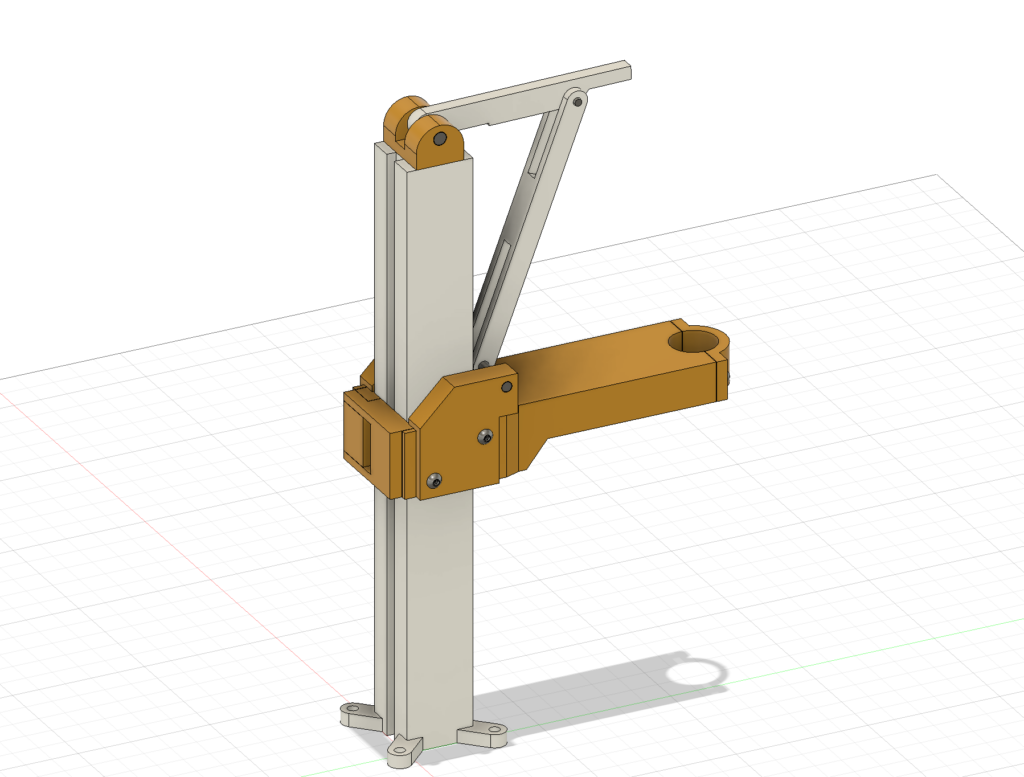
Prior to the current design and final print, there were two other designs made and considered. The main differences of the two where the lever to control the motion and the design of the components for the assembly. The first version utilized the lever mechanism but had too many separate components that when fully assembled altered the desired precision of the press. The second version did not include the lever, but each parts purpose was more carefully considered for assembly. For the third and current design the lever mechanism was re-adopted along with the new designs of the components.
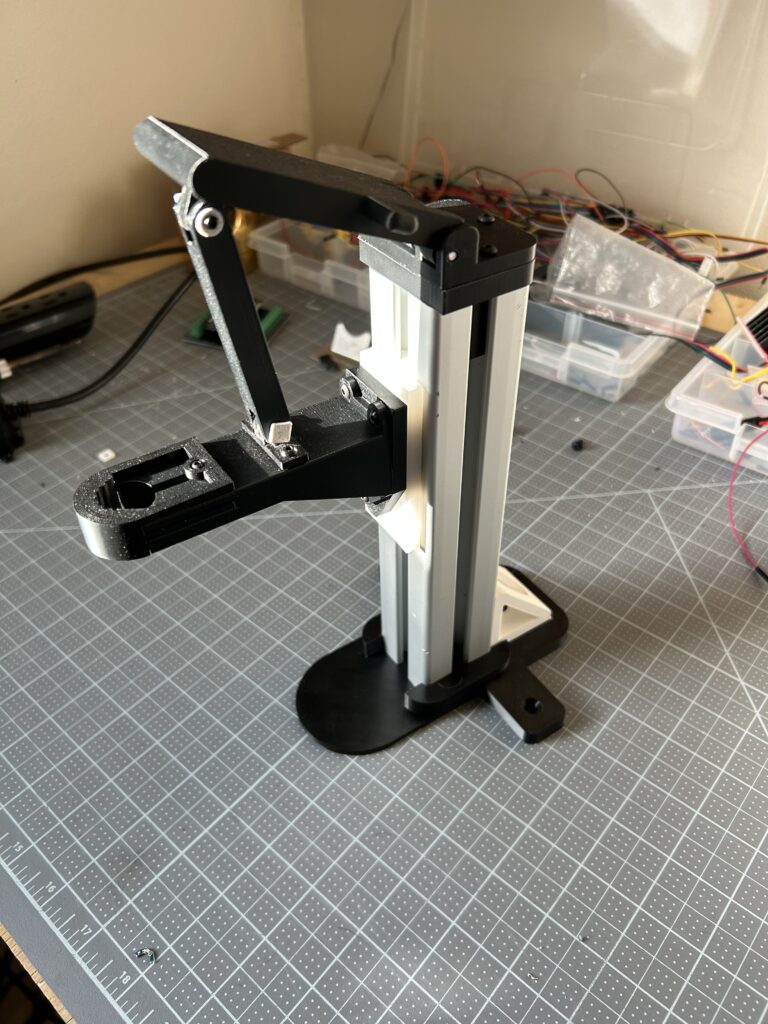
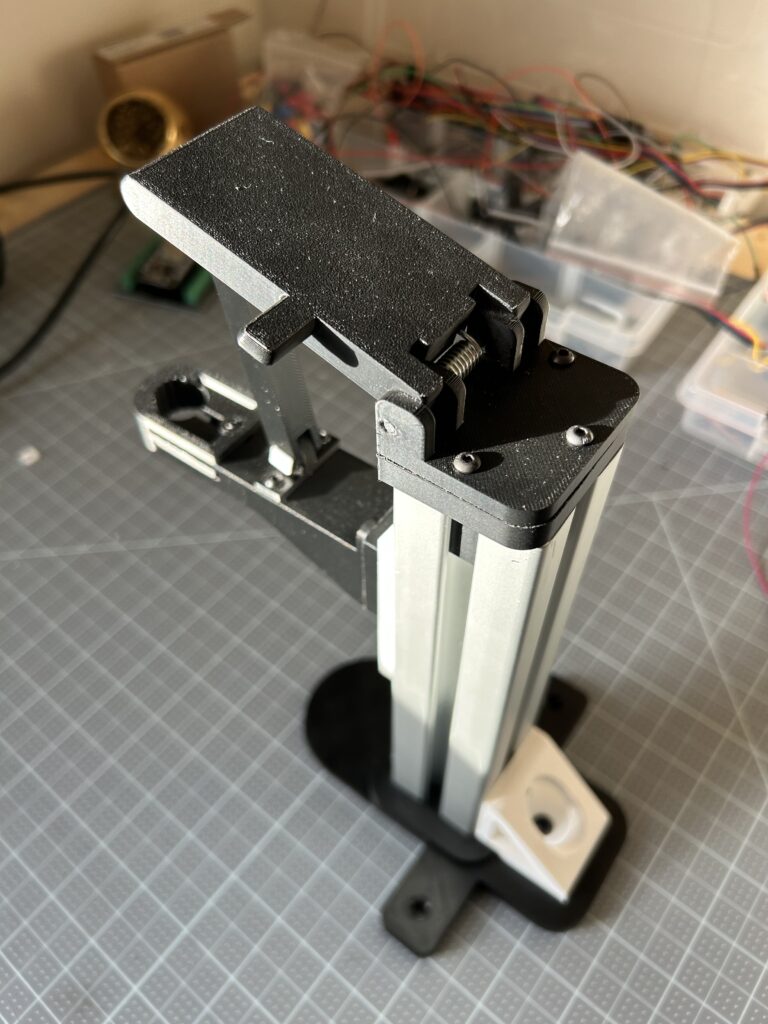
This is the newest design of the Heat Set Insert press with multiple improvements.To improve the accuracy and reliability, the previously 3D printed rail was swapped for a custom length T-Slotted piece of aluminum extrusion and linear bearing pad. A second improvement comes from the adjustable front clamp that holds the iron, by loosening or tightening the screw you can slide the clamp to easily remove or secure the iron. Another improvement came from replacing the exterior rubber bands with a coil spring that resits the movement and keeps the iron in a fixed position above the base when not in use.